Having an overbite or underbite can not only be visibly noticeable, but can also result in long-term oral health issues or chronic discomfort.
As our jaws have gotten smaller over time, having an improper bite, also called a malocclusion, has become more common, with overbites or underbites being two of the bite problems people can experience with their tooth and jaw alignment [1].
How can your overbite or underbite change your smile and lead to chronic health issues? Let’s take a closer look at the connection between malocclusions such as these and your oral health.
Problems Overbites Can Cause
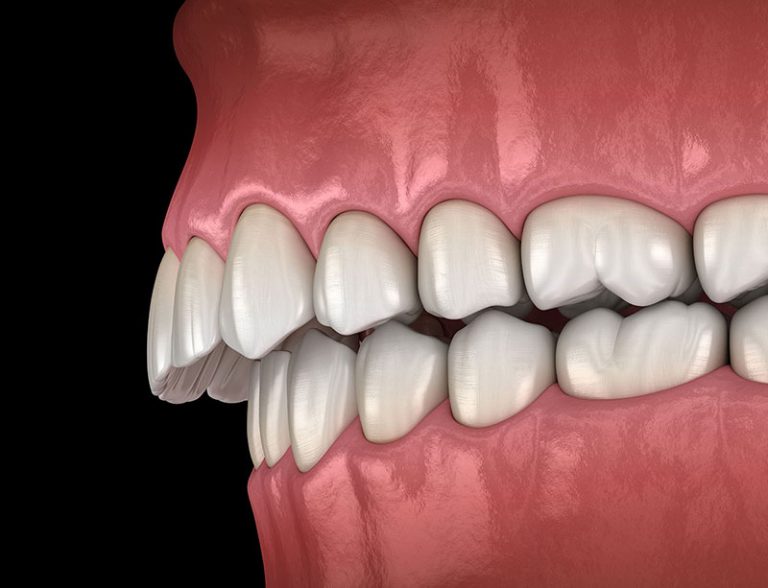
An overbite is when your front teeth essentially cover or overlap your bottom teeth. Overbites can mean that your upper teeth completely cover your bottom row of teeth when you smile or bite down, or it can mean that your upper jaw comes too far forward, leaving a space between your upper and low teeth when your jaws are closed.
If you have an overbite, you may have trouble closing your mouth completely, have difficulty with speech, or have discomfort while eating [2]. Overbites can also cause chronic jaw pain and lead to an increased risk for tooth decay and gum disease as a result of the lower teeth rubbing against the gum tissue on the back of the upper front teeth. Although overbites can happen due to genetics, thumb sucking and pacifier use past the age of three can also contribute to overbite formation.
Underbites and Oral Health
An underbite is when your lower teeth actually overlap your upper row of teeth. In underbites, your lower teeth will come out further than your upper teeth. Underbites are not as common as overbites, but are still one of the more common bite problems.
Like overbites, underbites can cause problems with chewing and speaking. Moving the jaw may also be uncomfortable, and can result in jaw tension or headaches. People with underbites may also be at higher risk for mouth breathing, which can increase risk for dry mouth and, as a result, tooth decay and gum disease.
If you have misaligned teeth combined with an underbite, you may also have trouble keeping your teeth clean, which can further increase your risk for oral disease.
Treatment Options for Malocclusions
Abnormal bites such as overbites and underbites typically become noticeable in childhood, which means that if you have your child evaluated for malocclusions early, you may have time to correct the problem before it causes oral health issues [3].
Treatment for overbites and underbites will depend on your specific smile. For some people, braces are a simple and permanent way to correct a bite. Other people may need to have teeth removed to correct their bite or have orthodontic devices to reposition their teeth.
In severe cases, such as with some underbites, surgery may be required to correct the condition. Following up with your dentist or orthodontist can help you discover your options for treating an overbite or underbite to reduce long-term oral health issues and improve your smile.
Sources:
1. https://news.stanford.edu/2020/07/21/toll-shrinking-jaws-human-health/
2. https://my.clevelandclinic.org/health/diseases/21473-overbite
3. https://www.mouthhealthy.org/en/az-topics/b/braces